
Atlas ActionEdge Project — Trade Automation
Discretionary edge, engineered into a system that can be audited. ActionEdge converts the Atlas indicator methodology into a governed, evidence-scored automation stack for S&P 500 and Nasdaq-100 futures — one in which every decision is typed, hashed, journaled, and reversible.
Why It Matters
Most retail automation fails in one of two ways: it hard-codes a signal and trades it blindly, or it wraps a black-box model that no one can interrogate after a loss. ActionEdge rejects both. The project's premise is that a trading edge is only durable when its reasoningis as observable as its P&L.
The stack begins where AQS research already lives — the Atlas indicator suite running on NinjaTrader 8 Renko charts for ES and NQ. Trend, regime, momentum, market-profile, and session-level telemetry is exported as frozen, schema-validated JSON and streamed to a scoring layer that produces a single, explainable verdict: gear, scenario, and leader. A confluence-lead-lag read on ES and NQ is treated differently from a sticky or conflicting one, and the system says which it saw and why.
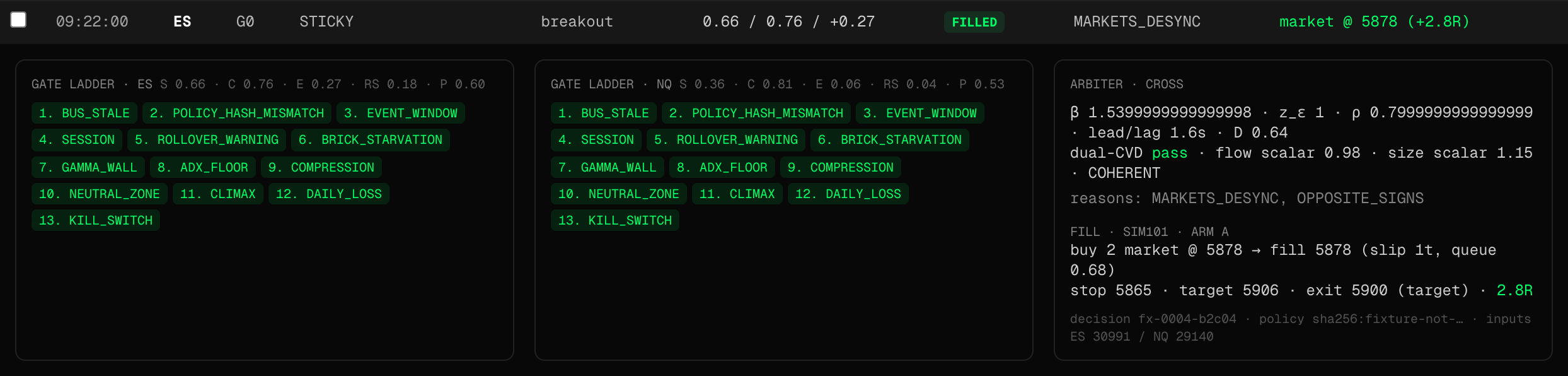
Execution is deliberately two-key. The NT8 strategy consumes decision IDs exactly once, applies its own vetoes, and routes through predefined ATM templates. A decision the scoring layer likes but the execution node distrusts does not trade. This asymmetry — permission is earned, refusal is free — is the core risk philosophy of the project.
The Learning Loop
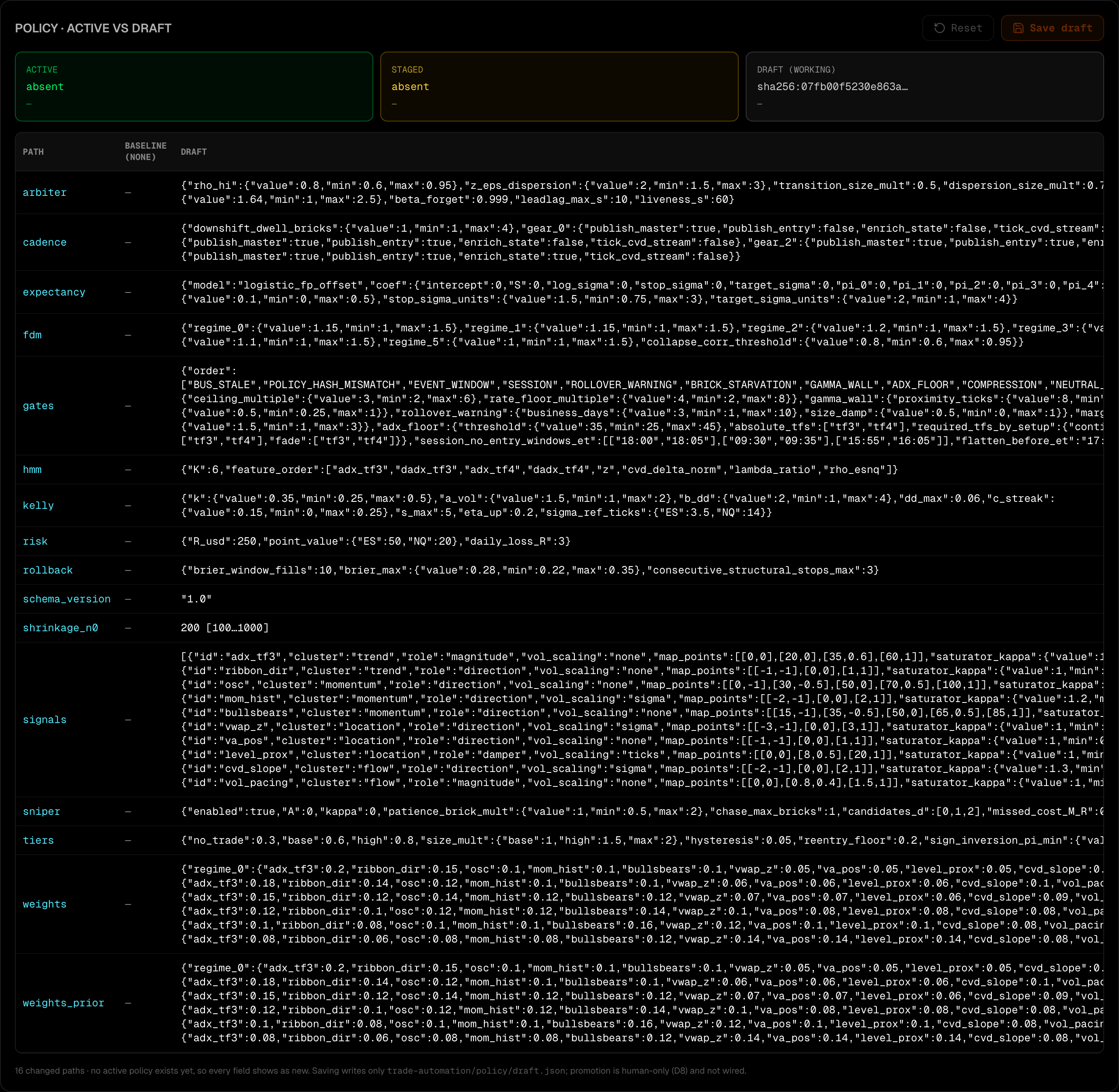
Every decision, its inputs, and its eventual outcome land in a versioned DuckDB/Parquet lakehouse. Nightly calibration re-estimates expectancy, re-fits regime models, and proposes policy adjustments as drafts. Drafts are diffed against the active policy, bounds-checked, and content-hashed. Nothing is promoted without a human reading the diff. The loop learns; it does not self-authorize.
The Decision Journal
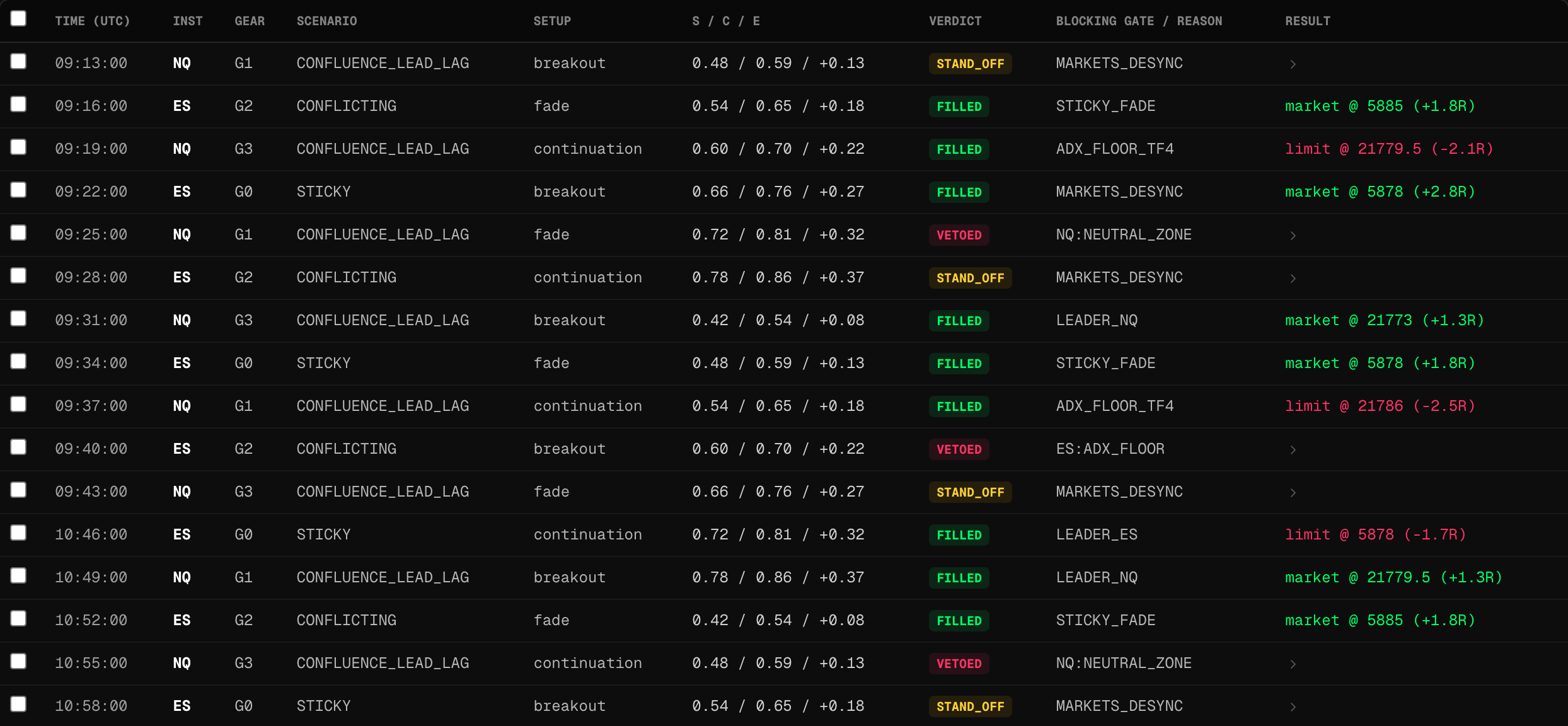
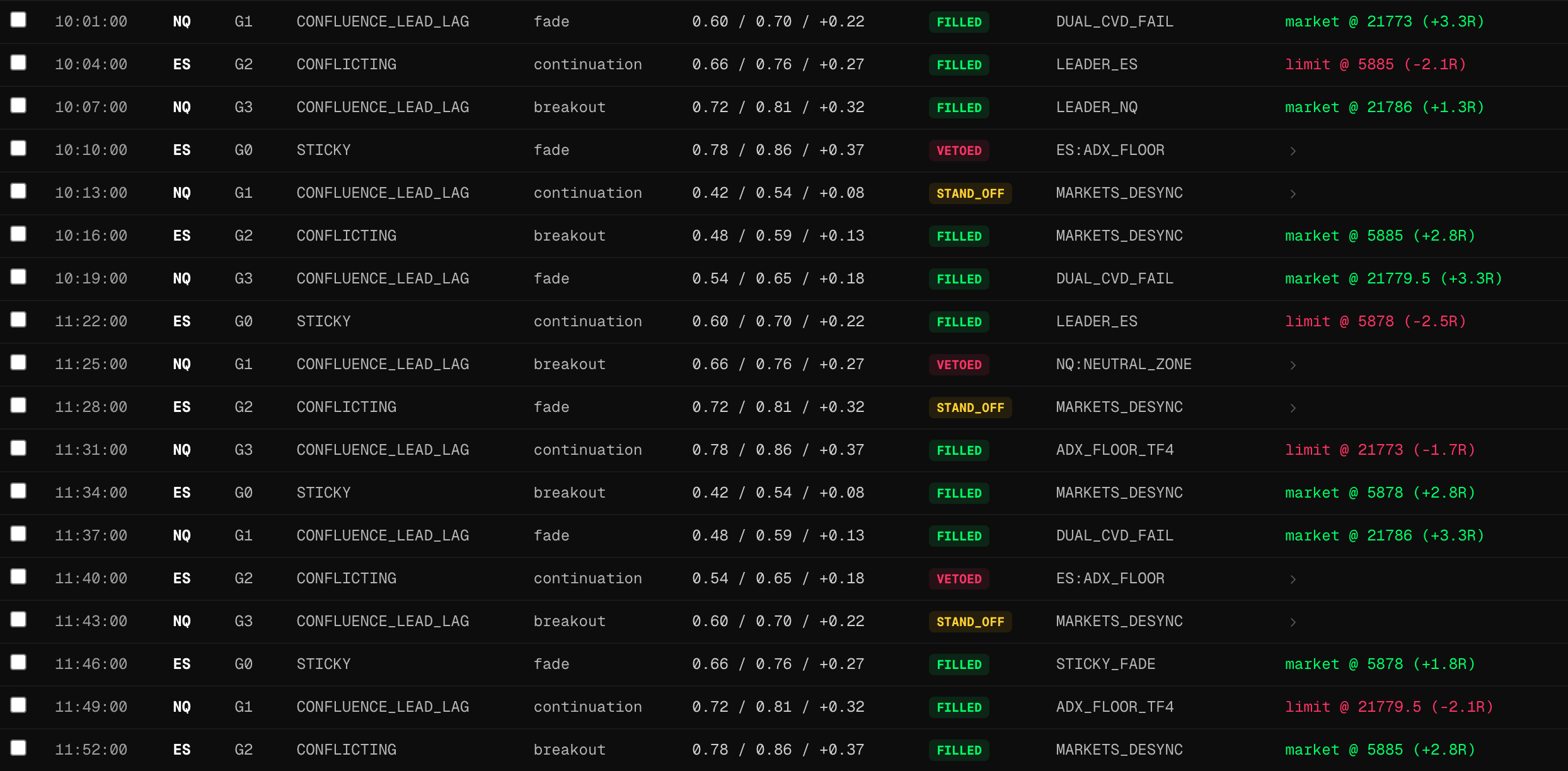
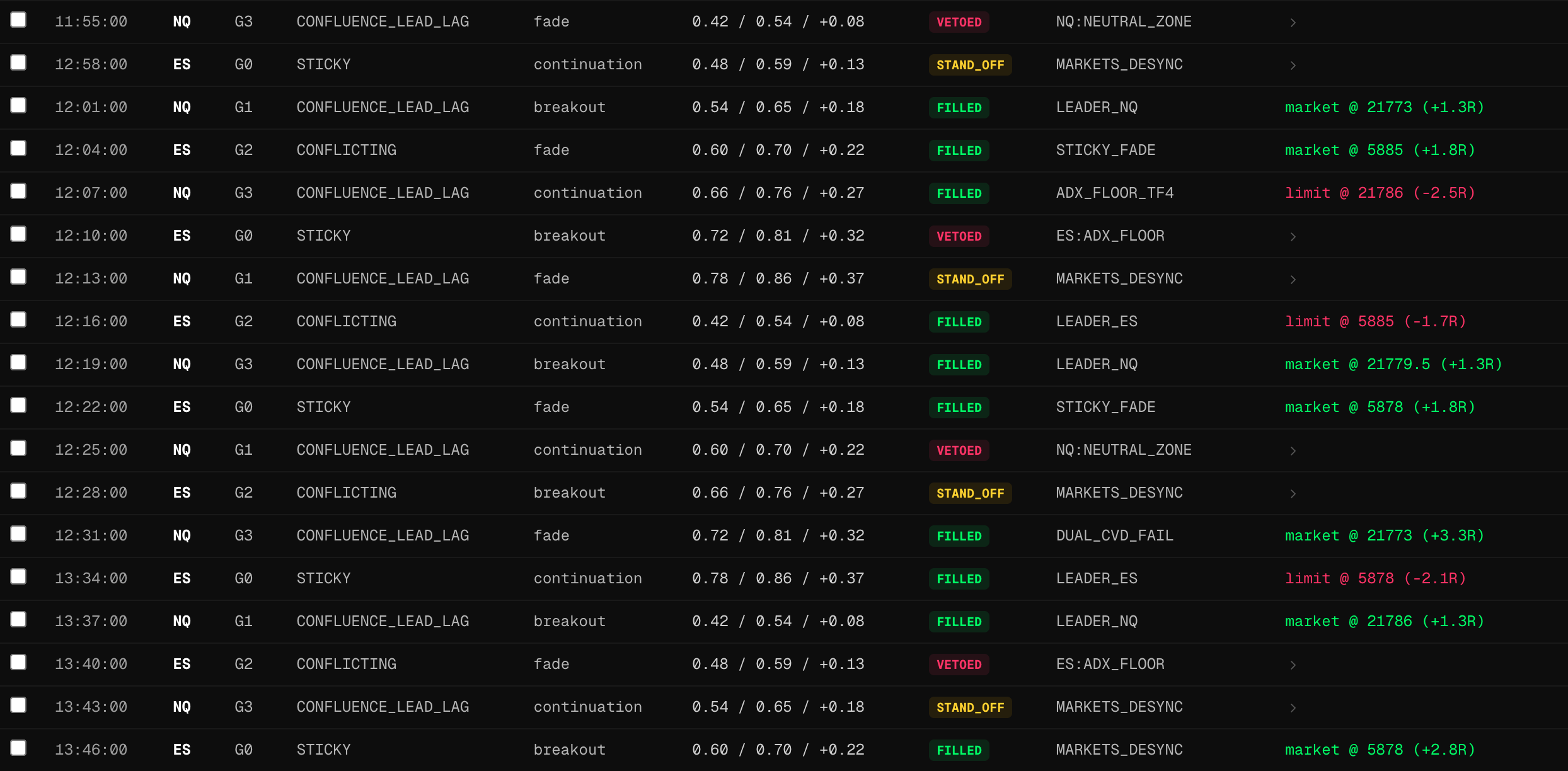
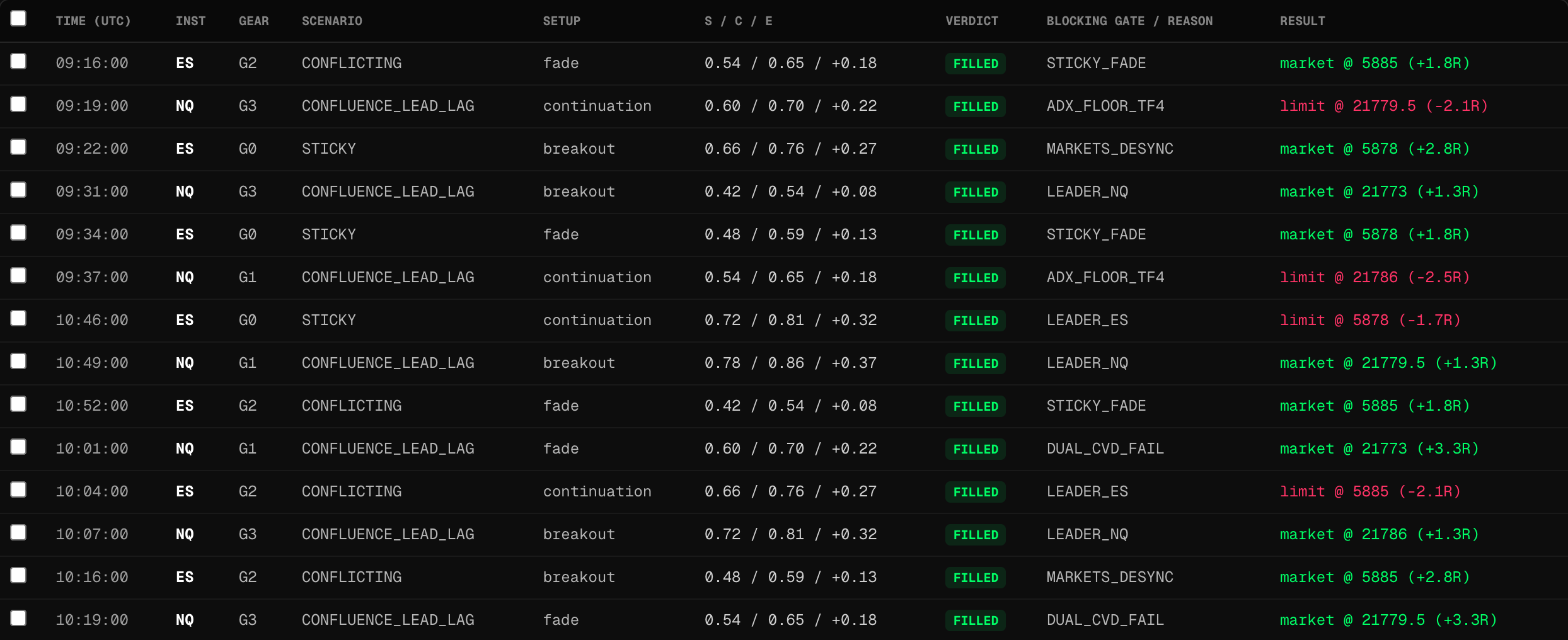
Every observation the engine makes becomes a row: time, instrument, gear, ES×NQ scenario, setup, the S / C / E score triple, the verdict, the first gate that blocked it, and — for fills — the entry and realised R. Stand-offs and vetoes are recorded with the same rigour as trades.

Governed Handles, Not Hidden Knobs
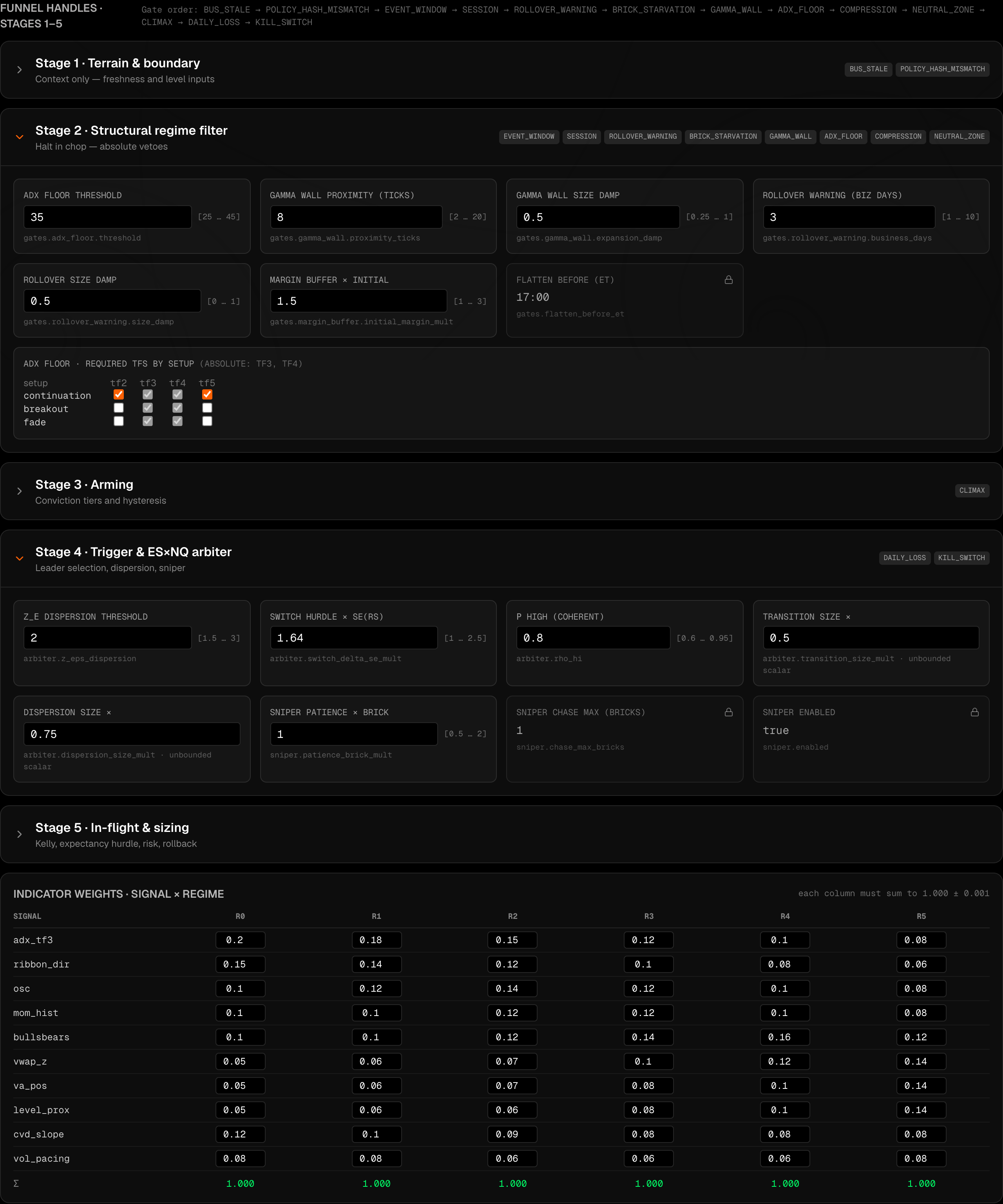
Every tunable parameter is exposed with its bounds, its JSON path, and its lock state. The funnel is staged so a change to a Stage-2 veto is never confused with a Stage-5 sizing tweak, and the policy diff shows exactly what a draft would change before anyone can save it.


Three-Node Control Plane
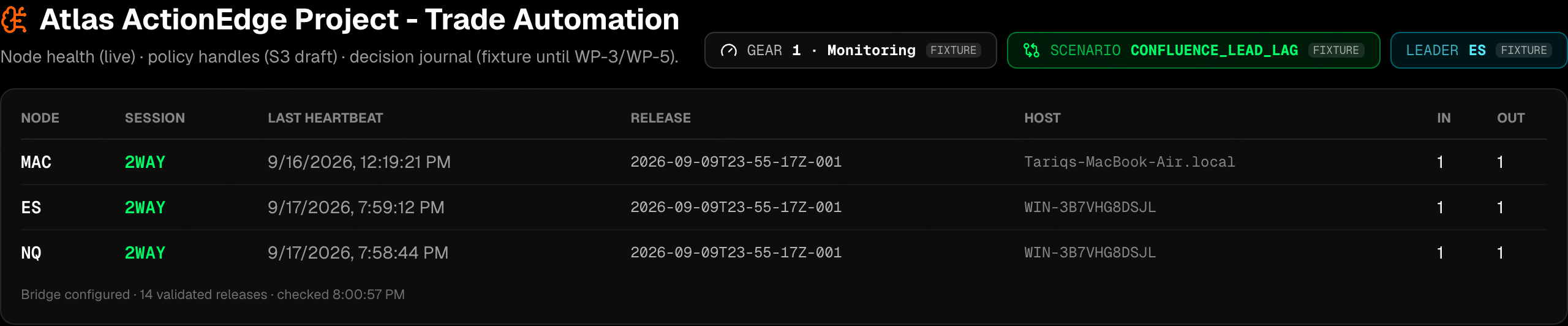
A Mac research and control node, an AWS broker/overseer tier, and dedicated ES and NQ execution nodes exchange typed, hash-verified telemetry over a persistent MQTT fabric with last-will detection. If any node goes dark, the system knows before a trader does.
Gated Scoring & the Gear Ladder
Every ES/NQ observation passes through hard gates, normalization, a composite conviction score, and an expectancy model before sizing is even considered. Permission advances through four gears — Dormant, Monitoring, Armed, In-flight — and can only step up when evidence agrees.
Regime-Aware Intelligence
Hidden Markov and Bayesian online change-point models classify the session regime and flag structural breaks. Lead/lag confluence between ES and NQ is scored explicitly, so the engine distinguishes a confirmed rotation from noise.
Human-Only Promotion
Policy changes are drafted, diffed, hashed, and staged — never silently activated. Promotion to a live policy requires a multi-node activation quorum and human sign-off, with an automatic rollback breaker as a non-negotiable release gate.