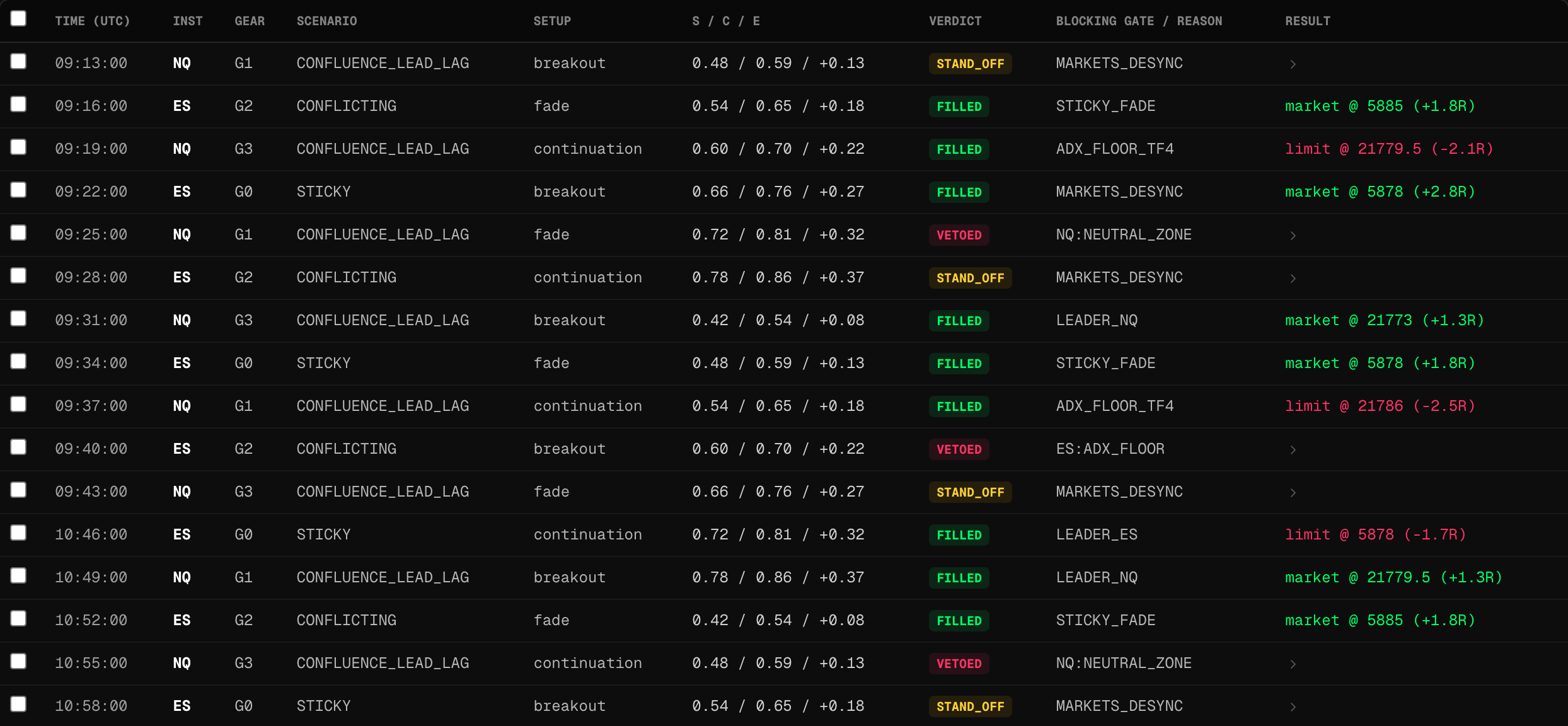
ActionEdge Portal · Decision Journal
Trade log / Sim101ActionEdge Project — Trade Automation Systems
Enabling market intelligence with quant computing algorithms and Recursive Learning Technologies. ActionEdge turns discretionary futures research into an inspectable operating system, moving from Gaussian Plane to Markovian Methodology and Bayesian Change-Point Detection Systems so every decision can be reconstructed, challenged, and learned from.
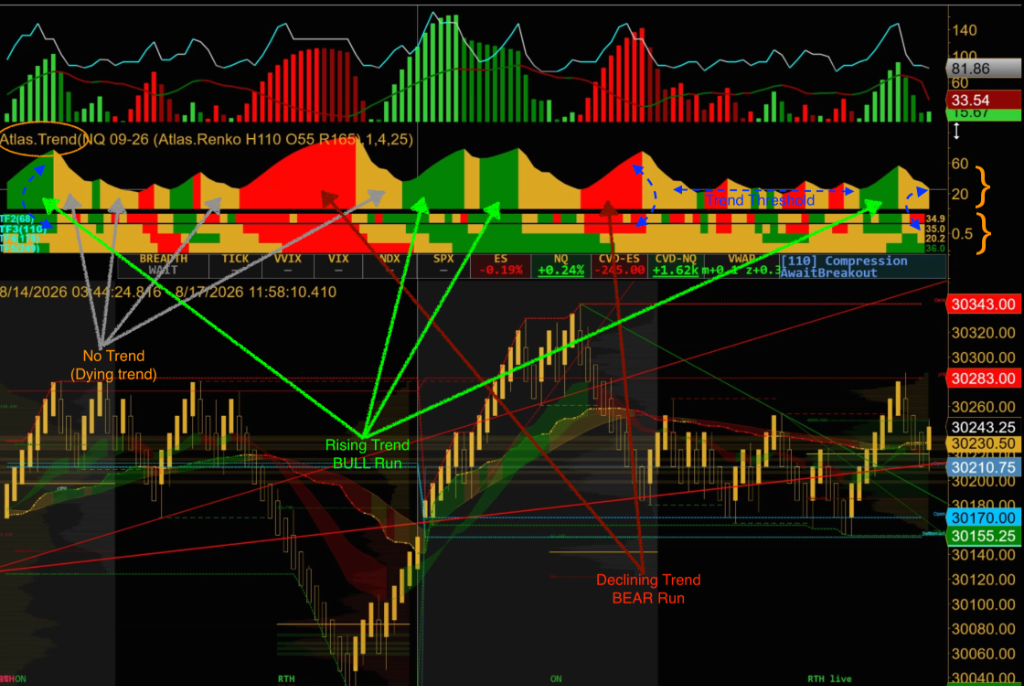
ActionEdge starts with the Atlas indicator stack and asks what it takes to make a trading decision reviewable. Quant computing turns each observation into a record with context, gates, conviction, execution state, and outcome. Recursive learning then carries the system from a Gaussian Plane, through Markovian regime methodology, into Bayesian change-point detection that can recognize when the market has structurally changed.
Three-node control plane
A Mac research node, an AWS broker/overseer layer, and dedicated ES/NQ execution nodes monitor each other with heartbeat checks and last-will detection.
Gated scoring
Signals pass through regime filters, normalisation, conviction scoring and expectancy checks before any sizing is even considered.
Regime-aware logic
ES/NQ lead-lag relationships, regime changes, and cross-market arbiter checks are measured before a decision is promoted.
Human-only promotion
Policy drafts are diffed, hashed, and staged, but only a human approves live policy changes and rollback conditions.
Inside the case study
The longer case study follows one decision from node health through gate evaluation, journal entry, policy review, and post-trade learning.