
The trading dilemma
Markets do not remain in the conditions under which a strategy was calibrated. A trend-following rule can struggle in a range; an execution assumption can fail when liquidity thins; a convincing backtest can reflect selection bias rather than a repeatable effect.
Discretionary trading brings human judgment, but also fatigue and execution inconsistency. Fixed-rule automation brings repeatability, but can respond poorly when its assumptions stop holding. Continuously retraining a model is not automatically a solution: adaptation without controls can fit temporary noise and increase exposure at the wrong time.
ActionEdge explores a different division of responsibility: fast inference, slower structural diagnostics, and offline research under human governance. The objective is not to eliminate uncertainty. It is to make uncertainty, entry permissions, risk limits, and model changes inspectable.
The program focuses on CME E-mini S&P 500 (ES) and Nasdaq-100 (NQ) futures. This article explains the proposed research architecture, not a verified performance record or an offer of a live trading product.
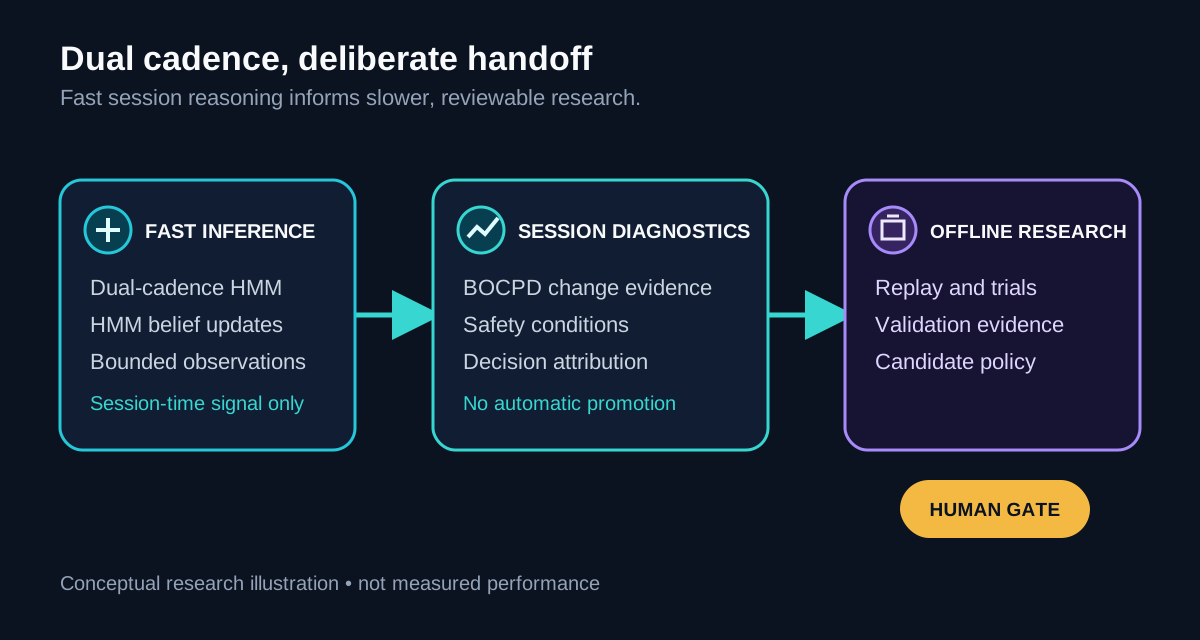
Open full-size illustration
Pillar 1: The fast-reflex engine
Beyond the light-switch trap
A hard threshold can turn a small change in an indicator into a large change in behavior. If observations repeatedly cross that boundary, an automated strategy may alternate between actions and accumulate spread, commission, and slippage costs. Probability-weighted analysis is one way to study that problem; it is not a guarantee that whipsaws disappear.
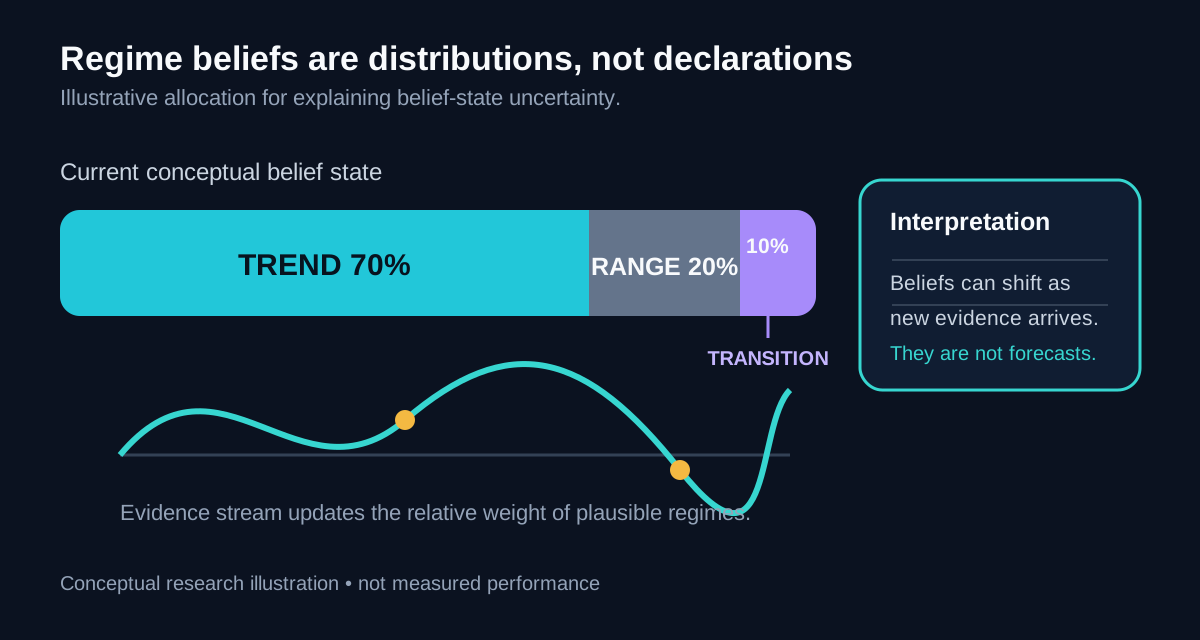
ActionEdge's hierarchical Hidden Markov Model (HMM) research treats market regimes as latent states inferred from observable evidence. A slower market context informs faster entry-level analysis. Rather than declaring the market unambiguously “trend” or “range,” the model maintains a distribution over possible states.
An illustrative belief vector might assign 70% to trend, 20% to range, and 10% to transition. These are teaching values, not measurements from an ActionEdge session. A posterior probability is also not the probability that a trade will win.
Open full-size illustration
Continuous belief modeling with hard safety limits
The intended fast path combines order-flow observations, volume information, and multi-timeframe indicator facts. The local sidecar validates freshness and policy consistency, evaluates entry gates, and computes signal strength, confidence, expectancy, and bounded sizing inputs.
- Smooth interpretation: regime probabilities can blend signal weights instead of switching every signal abruptly.
- Noise-aware participation: weak or conflicting evidence can block a new entry or reduce the proposed risk budget.
- Bounded execution experiments: simulated market and inside-brick limit entries can be compared for fill quality, adverse selection, and missed opportunities.
- Fixed authority: live inference uses the active policy. Learning a new parameter set belongs in the offline research process.
This is not a claim of microsecond execution, knowledge of exact queue position, zero chatter, or guaranteed low drawdown. Those properties require separate instrumentation and evidence.
Permission is not an order
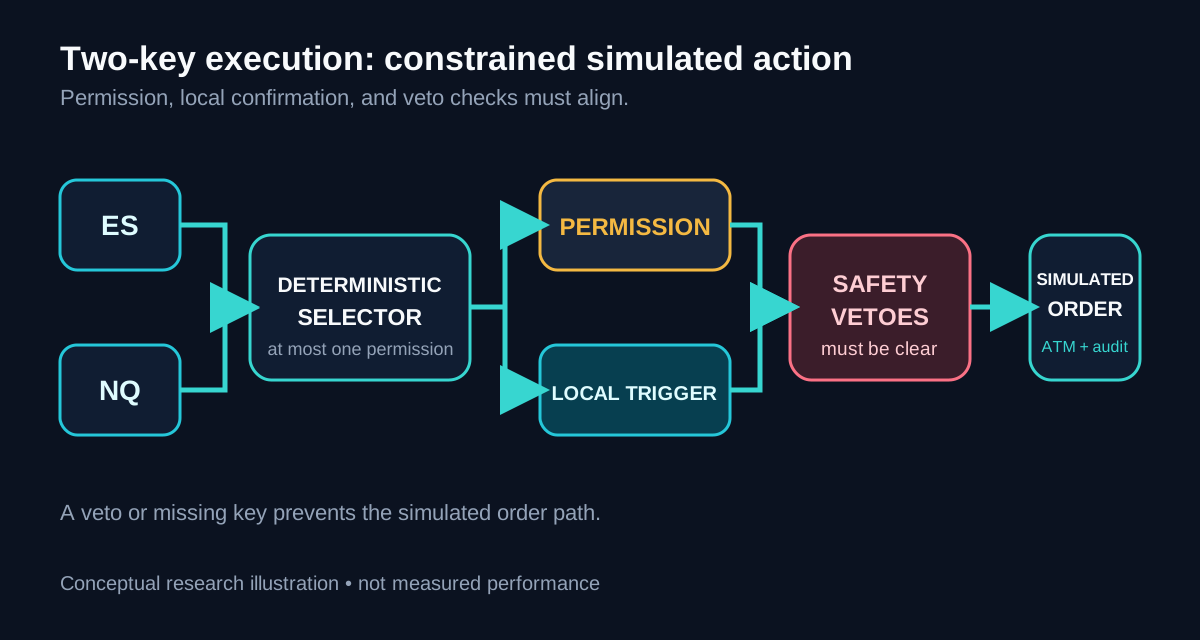
The distributed design has two instrument nodes and one deterministic coordinator. Local ES and NQ candidates pass through a shared messaging layer to an overseer that compares the instruments. The design permits at most one selected instrument, subject to cross-market coherence and risk controls.
The owning strategy still needs a valid permission, its local entry trigger, and clear local safety vetoes. An expired permission, policy mismatch, consumed decision identifier, inadequate margin, or active kill state must not become a new order.
One decision identifier authorizes one attempt, not repeated retries until something fills. Broker-side ATM stops and targets form part of position protection; their actual placement and behavior must be verified in simulated runtime tests.
Open full-size illustration
Pillar 2: The macro climate radar
Detecting changes in the process
A model may continue to classify individual observations while the process generating them has changed. ActionEdge's slower diagnostic layer studies this distinction using Bayesian Online Change-Point Detection (BOCPD).
BOCPD tracks uncertainty about the length of the current statistical regime, often described as its run length. New evidence changes the relative support for continuation versus a new segment. Its conclusions depend on the observation model, prior assumptions, and quality of the input data.
For this research design, structural diagnostics operate on session-level evidence. “Online” describes sequential Bayesian updating; it does not mean a session-close diagnostic can anticipate every intraday shock.
The proposed diagnostic scorecard asks:
- Did realized volatility and strategy outcomes remain consistent with the model's expectations?
- Did slippage, fill quality, and execution efficiency deteriorate?
- Did ES/NQ relationships remain coherent?
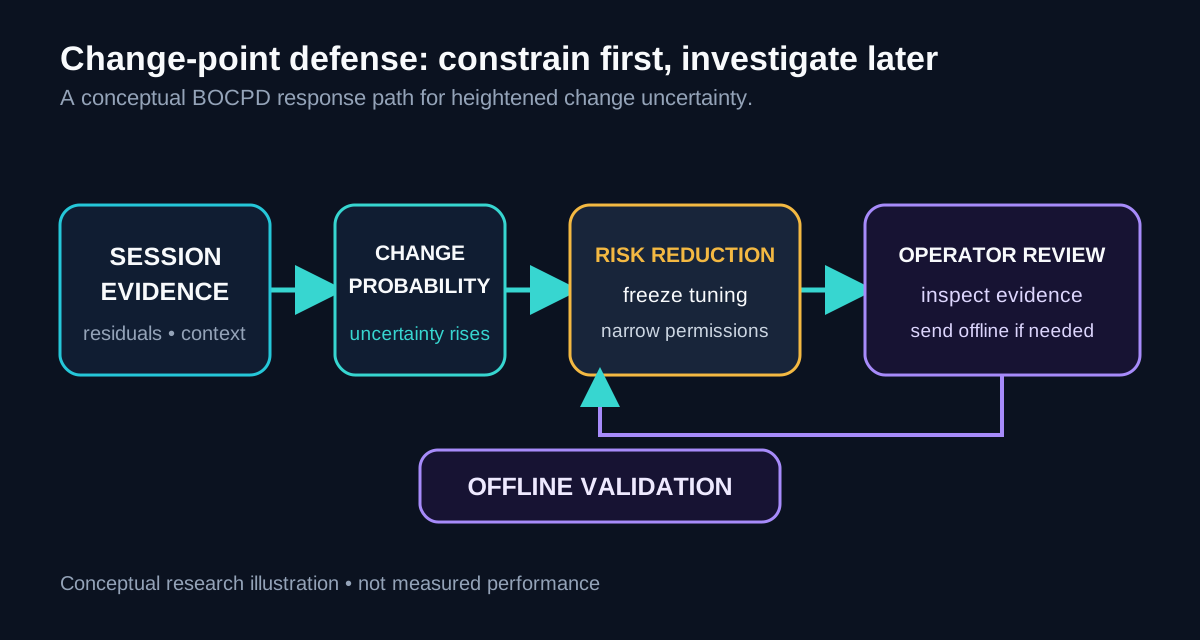
- Is there enough evidence of a change to justify a defensive response?
Open full-size illustration
Defensive responses, not a promise of protection
The source proposal uses a 50% sizing haircut as an example response to elevated structural uncertainty. That is a design parameter to validate, not a universally safe setting or proof of a deployed control.
The defensive pattern is to reduce the permitted risk budget, prevent opportunistic retuning into shock data, alert the operator, and require offline review before restoring a revised policy. Existing positions remain subject to the strategy's position-management and emergency controls; “no new entry” is not synonymous with “flatten everything.”
Risk reduction can limit exposure, but it cannot guarantee that losses stop or that a structural break is detected before a drawdown.
Pillar 3: The offline flight simulator
Research before capital
The flight-simulator analogy is useful because it separates experimentation from operational execution. Proposed changes should be replayed, challenged, and reviewed before they can influence an active policy.
The evidence store brings together recorded snapshots, decisions, gate reasons, and fills. The fidelity of a replay is bounded by the data actually recorded. Tick-level depth, exact queue position, and microsecond execution records must not be assumed when they are unavailable.
Research can investigate questions such as:
- Does a candidate retain its behavior across trend, range, and transition periods?
- Does a limit-entry policy improve realized outcomes after missed fills and adverse selection are included?
- Does the result survive realistic transaction costs, execution delays, and stressed volatility assumptions?
- Is the apparent improvement concentrated in one instrument, setup, or entry mode?
Open full-size illustration
The Crucible and the lucky-fluke problem
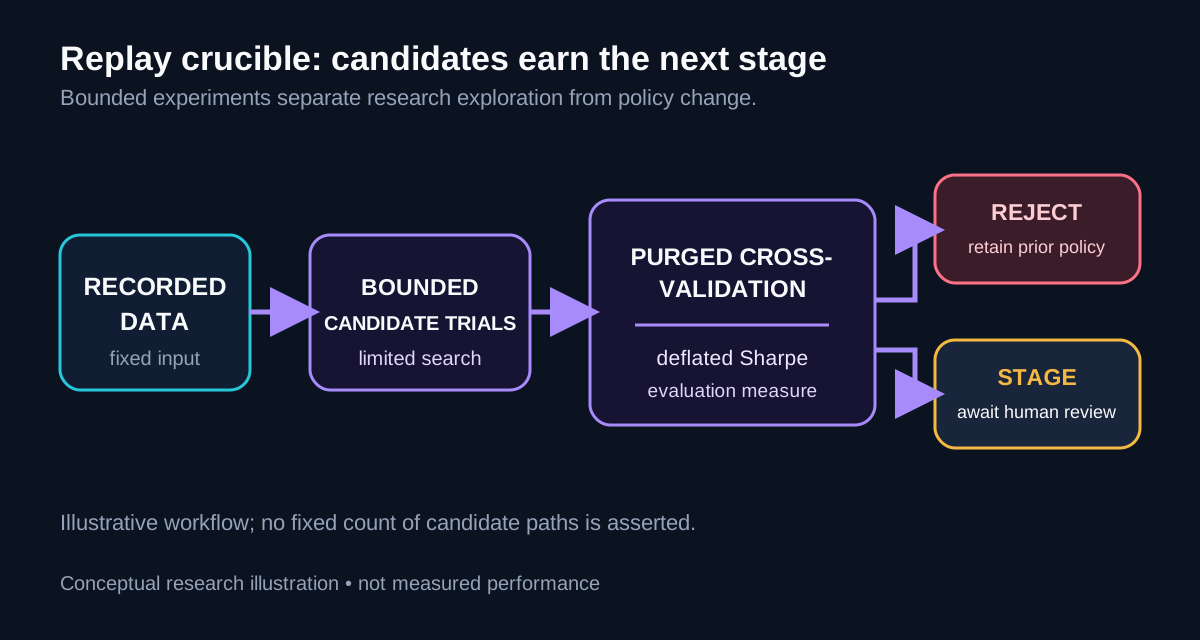
Testing many variations makes a seemingly impressive result easier to find by chance. A validation process therefore needs to account for both dependence in financial data and the number of ideas tried.
Purged, embargoed cross-validation reduces leakage between training and evaluation windows. Combinatorial paths can probe stability across different partitions. The source manuscript proposes a 28-path design; the correct path count depends on the actual configuration and does not, by itself, establish independence or statistical validity.
Deflated Sharpe evaluation addresses selection effects and non-normal return distributions under its assumptions. It is one piece of evidence, not a statistical guarantee. The trial registry must count unsuccessful candidates as well as selected ones.
The public research record here does not establish that thousands of scenarios have been completed, that a particular fraction of candidates passes, or that any candidate is profitable. The acceptance criteria must be evaluated on actual results.
Pillar 4: Human-governed improvement
Autonomous research, governed execution
In this article, RSI means recursive strategy improvement, not the Relative Strength Index oscillator. The improvement loop can propose hypotheses, run bounded trials, and prepare evidence. It must not grant itself authority to promote an active trading policy.
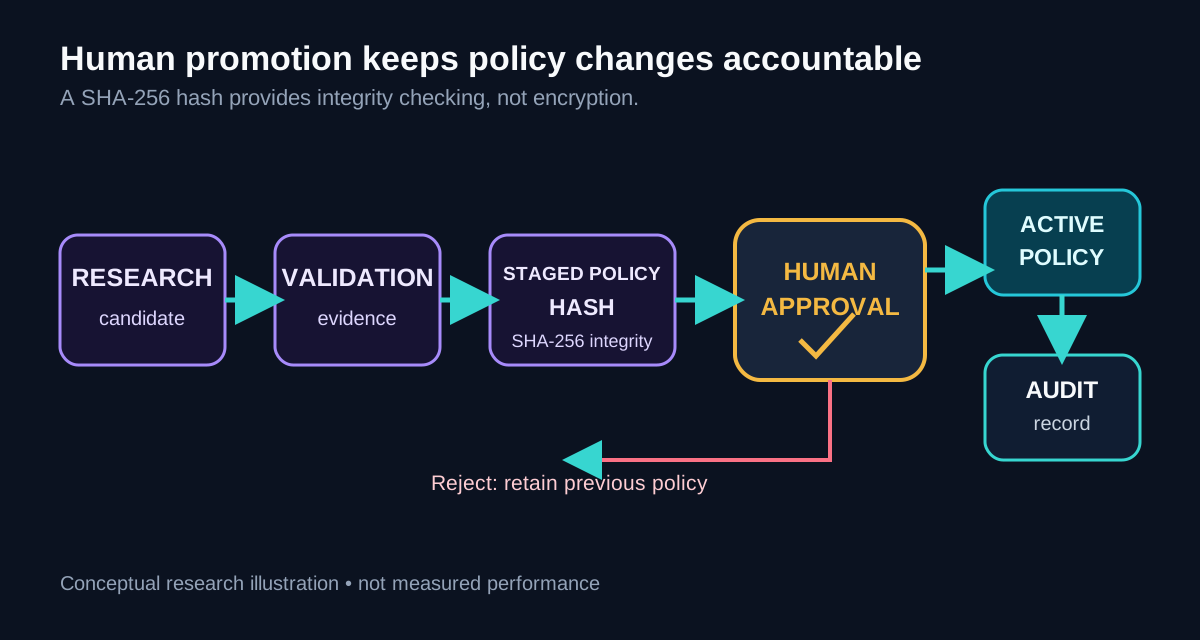
The intended promotion sequence is:
- Register a hypothesis and trial. State the proposed change and the evidence required to accept or reject it.
- Run bounded offline evaluation. Preserve unsuccessful results and account for the full search.
- Stage the candidate. Attach a version, policy hash, parameter differences, validation results, and rollback reference.
- Require human review. An authorized operator decides whether the evidence justifies promotion.
- Verify activation and audit it. Participating components must agree on the active policy identity before new permissions are accepted.
Open full-size illustration
The policy gate is separate from the two-key entry rule. Human approval governs which policy is active; coordinator permission and local conditions govern whether one order may be attempted.
The design allows an automatic safety rollback to a previously validated policy under defined conditions. It does not allow automatic promotion of a newly discovered candidate or intra-session weight changes outside a governed process.
The evidence returns to research
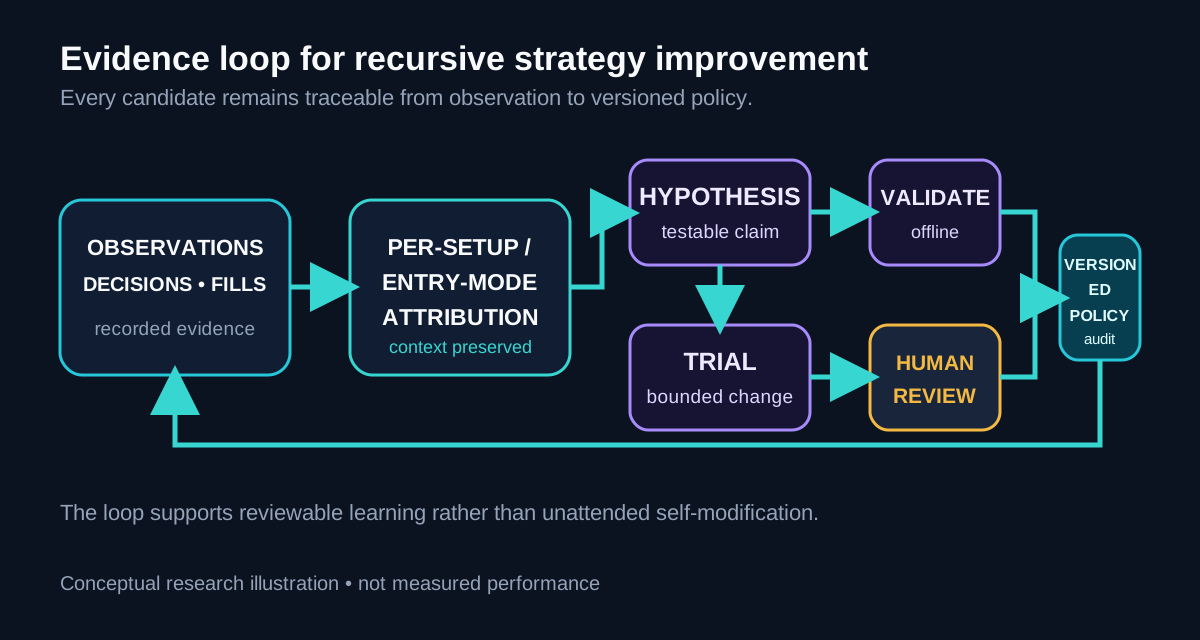
Each outcome closes a feedback loop: observations and gate decisions lead to fills or rejected opportunities; attribution is evaluated by setup and entry mode; a hypothesis enters a registered trial; validation either rejects it or produces a staged candidate for review.
The Mac research console is an observation and replay surface, not a required dependency of continuous execution. Operational heartbeats provide another, separate signal: they can show that a component is reporting, but they do not establish broker authentication, working protective orders, or permission to trade.
Open full-size illustration
What the architecture aims to improve
The comparison below describes design choices, not measured superiority over manual trading or other automated systems.
| Dimension | Common challenge | ActionEdge research approach |
|---|---|---|
| Execution consistency | Fatigue, discretionary drift, or repeated threshold crossings | Deterministic permissions with local triggers and explicit vetoes |
| Market interpretation | Treating regime classification as certain | Continuous HMM beliefs with uncertainty-aware gating |
| Structural change | Applying a calibration after its assumptions weaken | Session-level BOCPD diagnostics and bounded defensive responses |
| Strategy validation | Selecting the best of many noisy backtests | Registered trials, leakage controls, and selection-aware statistics |
| Risk budgeting | Static exposure disconnected from conditions | Bounded sizing with drawdown and policy constraints |
| Governance | Unreviewed parameter changes | Staged, versioned policies and human-only promotion |
| Accountability | Incomplete reasoning or outcome records | Linked snapshots, decisions, veto reasons, and fill evidence |
Designed for serious futures research
ActionEdge brings indicator facts, probabilistic analysis, execution discipline, and research governance into one inspectable workflow. The ambition is a system in which a decision can be reconstructed and challenged, and where an unconvincing result can be rejected without affecting an active policy.
Its ES/NQ focus does not remove futures-market risks. Simulation cannot fully reproduce live fills, outages, liquidity constraints, or behavioral and operational failures. Neither a model nor a protective order eliminates the possibility of substantial loss.
Explore the ActionEdge case study for the control-plane and decision-journal walkthrough, or visit AQS Education for the underlying market and indicator concepts.
Publication and evidence notes
This illustrated public edition adapts the AQS manuscript “Why Markets Break Traditional Automated Systems—And How AQS Solves It”, supplied as hierarchical_hmm_bocpd_rsi_research_article.md. Its four pillars and research narrative are retained. ASCII and Mermaid sketches have been replaced with seven original explanatory illustrations.
Editorial changes distinguish intended architecture from verified deployment and measured performance. Unsupported failure-rate statistics, latency claims, guaranteed outcomes, exact replay-volume and pass-rate claims, and descriptions of SHA-256 as encryption are not presented as established facts. The original manuscript is unchanged.
All figures are conceptual, not trading signals, backtest results, or live telemetry. HMM and BOCPD outputs depend on modeling assumptions and calibration. The article does not certify production readiness or disclose private infrastructure, credentials, model weights, or operational access paths.
Risk disclosure: ActionEdge is a research and engineering program in simulated validation, not a live trading product. Futures trading involves substantial risk of loss and is not suitable for every investor. Nothing here is investment advice or a promise of returns. Past or simulated performance does not guarantee future results.
© 2026 Atlas Quant Systems (AQS). All rights reserved.